This is an audio post, so I suggest listening.
Mister Rogers made Franz Schubert famous
I’ve been playing a lot of Schubert recently. I rarely played him when I was younger. Just the Musical Moment 3, in F-Minor. It’s a popular piece, in no small part because, in the ’80s, André Watts played it on Mr Rogers. I watched Mr Rogers, in fact I grew up near him, but I didn’t catch this episode until it was online.
Van Cliburn recordings made my childhood
Instead, I discovered the piece on a compilation called “The World’s Favorite Piano Music,” solo recordings by Van Cliburn. It was my first classical piano CD, given to me by mother in the early summer of 1997, when I was 13, after she signed me up for a trio of trial piano lessons.
I remember little about the lessons, except that I liked the instrument and my teacher enough to want to continue once our family completed a cross-country road trip in August.
In the meantime, I acquainted myself with the CD. Tracks two, three, and four represented a closed-circuit of budding classical piano obsession: Rachmaninoff’s prelude in G-Minor, Op. 23, No. 5, Beethoven’s Für Elise, and Mozart’s Turkish March.
Many of the pieces on the album would, in a few years, comprise my standard repertoire—Debussy’s Rêverie, Brahms’s Intermezzo in E-flat Minor—but those three I would abuse.
Mozart is a trap and a trick
I foresaw this future one day on the road trip. We were somewhere out west. Utah, I think. A hot and sunny afternoon in late August. I’d always loved maps and mountains, but Mozart made them better. I sat in the middle row of our minivan, hypnotized by the Turkish March.
To seal yourself off with headphones and listen to the piece for hours is an acutely recursive meta experience. The piece has five sections, then a coda. Not only do all of them but the coda repeat, but two are played twice, and one is played three times.
I’d never seen the score. I was scarcely able to play a scale. And I was years away from scratching the surface of postmodernism. But even then, I felt that the piece was a trap and a trick, a one-way maze with neither entry nor exit, a series of feedback loops that had existed for all of time, but remained suspended in space, hidden from humanity, until Mozart found an escape hatch.
Schubert fantasy
My first thought about why I never experienced Schubert like that was that maybe he wrote mature music. But what does that mean?
The scholar can explain, in exquisite, technical detail, how Schubert’s music becomes increasingly rich and textured and masterful as Schubert composes from 12 to 22 to 32. But does the lay listener care?
I wonder who can tell, for instance, that the clip three paragraphs above, a Schubert fantasy for four hands, is among Schubert’s first pieces, composed when he was 12 or 13, while this one, also a Schubert fantasy for four hands, is among his last.
Most people experience music first with their ears, then with their memories, and later on with their minds. We’re drawn to pieces because of when and where we hear them, as much as why and how they exist.
But tracking this with Schubert is tough. He wrote so much. Nine or ten symphonies (seven complete), lots of chamber music (string quartets; strings, winds, brass; piano and other instruments), lots of piano duets (marches, dances, overtures), twenty-one piano sonatas, so many miscellaneous piano pieces, a bunch of sacred masses and hymns, and hundreds of songs for multiple voices.
Altogether, over 1,500 pieces—and all composed before the age of 32, given that he died, officially of typhoid fever, unofficially of syphilis, at age 31. Though let’s remember that life expectancy was, for a middle-class Viennese guy in the early 19th century, about 34.4.
The New York Times reveals the top ten greatest composers
So when did I really start listening to Schubert? Well, in January of 2011, in the New York Times, Anthony Tommasini published his ranking of the top ten greatest classical composers. I was startled to see Schubert in fourth place, behind Mozart, Beethoven, and Bach. It was one of those cinder block moments where I suddenly became aware of the world’s immensity.
It was easy to admit it, though, if it meant more Schubert. Tommasini writes that Schubert’s early symphonies, “may be works in progress.” But when I soon heard a catchy tune on the radio and learned that it was the first movement of Schubert’s Symphony No. 2, I knew instantly that had to tell everyone about it.
The implied conceit of my three-paragraph plea was that the piece reminded me of something—and then I learned that Schubert wrote it to correspond to a Beethoven ballet, the overture to The Creatures of Prometheus.
Rachmaninoff: the last romantic
So things were clicking into place. Beethoven was my teenage obsession, along with Rachmaninoff.
Rachmaninoff’s a mystery: an all-time practitioner and a stand-in for the Russian soul. His playful, sorrowful sorcery, his thick post-/neo-Romantic note babble make his pieces not just compositions, but conquests.
I spent a year of high school perfecting the 23-5 prelude and two years of grad school, where I was a writing student, pretending I was in Shine, the Oscar-winning movie about David Helfgott’s torturous adventures in Rachmaninoff’s Piano Concerto No. 3.
The more I invested in Rachmaninoff, the more I attuned I became to his shortcomings. But I still indulged. Take the Prelude in C-sharp Minor. Rachmaninoff composed it shortly after he graduated from the Moscow Conservatory, when he was 19. It made him insta-famous, and he came to loathe it.
I knew it from the Van Cliburn recording, but Rachmaninoff’s is my favorite. His playing is always clean and crystalline, self-conscious yet self-assured, furious yet cautious, rushed and halting, unlike anything you might expect, as Daniel Barenboim has pointed out. In the prelude, I love how Rachmaninoff whisks the underbelly of the Agitato section as if summoning the melodic storm with mild irritation.
(Most renditions are fine, but a few years ago I heard it anew. It was the Carnegie Hall debut of Dmitry Masleev, and he drove the prelude with that three-note motif, hollowing it out to a mesmerizing sample and opening the spatial possibilities. That’s how I remember it, anyway, and how I’ll have to: I can’t find a single clip of him playing it.)
And then there’s Rachmaninoff’s Piano Concerto No. 2, as close as classical music has to a smash hit. Regular people will buy pricey tickets to hear anyone toll those tense gateway chords before the furious arpeggios slip underneath the orchestra’s rushing, graphic beauty.
Rachmaninoff started composing the piece in the autumn of 1900 and finished the following April. It was his first piece after years of hypno- and psychotherapy, which he sought to deal with his depression after the failed debut of his first symphony. Decades later, the beloved concerto would find a home in Hollywood, and the music industry, from Sinatra to Celine Dion, glommed on. Rachmaninoff can always choke you up.
Beethoven and the universe
With Beethoven you weep, tingle, and rage. If the omniscient opening of Beethoven’s fifth symphony best represents the urgency with which he can channel human drama, his colossal ninth symphony, which he wrote when deaf, epitomizes what Leonard Bernstein calls the universality of Beethoven’s music.
But Beethoven made gargantuan contributions to the piano literature as well. His thirty-two sonatas are considered the New Testament of the western classical piano canon. I poked around the early and middle ones in high school, and a few years ago started working through the more challenging middle and later works: the Tempest, the Waldstein, the Appassionata, Les Adieux, the Hammerklavier, and the final three, so boundary-pushing they’re known only by their opus numbers: 109, 110, and 111.
The last one is sublime. Beethoven opens in the grip of C-Minor terror and, twenty minutes later, gives a celestial sendoff in C-Major. Along the way, he manages to invent ragtime.
Schubert on screen
Schubert’s final sonata is equally as masterful—but not because it’s twice as long. It’s the opening that repeat listeners always conjure, that pulsating, lapping melody that makes you feel like you’re joining a piece in progress. And then it stops, and we hear what András Schiff told Alex Ross is “the most extraordinary trill in the history of music.”
A few years ago, I listened to the piece while at a friend’s house. Later that evening, on a whim, we watched Ex Machina, a movie about a computer programmer who administers Turing Tests on an intelligent humanoid. In a quiet, pivotal scene, the opening bars of the Schubert play. It was an eerie coincidence, with a deceptive element: the piece is not soundtrack—it’s what the humanoid is listening to.
But perhaps the most brilliant use of Schubert on screen comes from Barry Lyndon, Stanley Kubrick’s 1975 film about an 18th Century social climber. It’s a tragic story, shot with majestic texture, and the slow movement of Schubert’s Piano Trio No. 2 serves as its insistent, aching heart.
The best Schubert melodies
Near the end of his life, Schubert wrote some impromptus, single-movement pieces. There are 11, if you include the unnamed ones, and three of them happen to feature the most contagious topline melodies.
The first is from the first impromptu, from the D. 899 set. The theme enters almost immediately and repeats in various permutations. First it’s spare, then it’s luscious, and then it shatters.
This next one is the first from the D. 935 set, and I love how it jumps and dances before dropping into lyrical mystery.
Finally, here’s my favorite, my true Schubert first love, a melody tucked inside the second of the three unnamed pieces that comprise the D. 946 set. This would be a pleasant, frolicking little lyrical piece, a bit strange in its uncertainty, with you wondering where it’s all headed, were it not for this line.
Those are the pieces that inspired this post. And, you know, the funny thing is, last year, when I started listening to them, it took me a while to really hear these lines. And then I was entranced.
Schubert makes you freeze
But I think that’s the way it is with Schubert. He goes light and heavy and dark and light, often within seconds, and you need time to adjust. He forms intimacy through familiarity: you are wondering where you heard his tune right up until the moment you realize it is him. The saying about Schubert is that he’s sad in minor keys and tragic in major ones. But he doesn’t make you cry. You freeze.
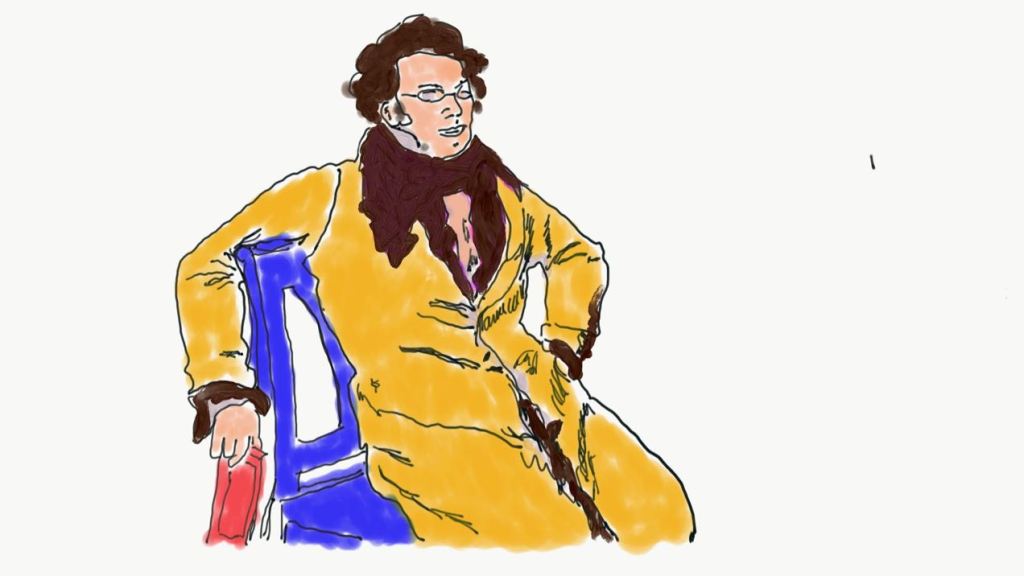
Art by Masha Udensiva-Brenner.
H/T to Kate Adler for life expectancy research.

 Nathan Schiller
Leave a reply to My blog has a name: Angles in America | Angles in America Cancel reply